
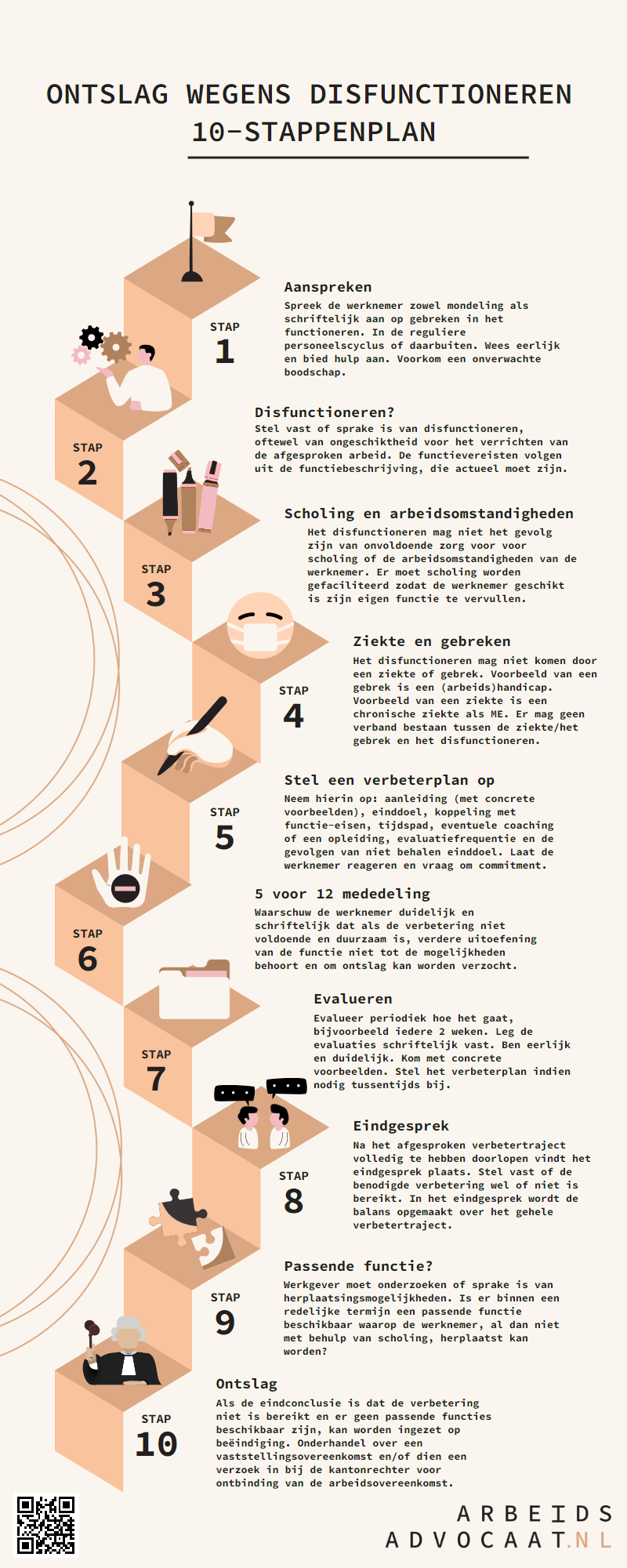
This blog presents a practical step-by-step plan that can be followed when an employee is dysfunctional. In order to ultimately arrive at a dismissal for dysfunction, dossier compilation and the improvement process are particularly important. The cantonal judge will only grant dismissal for dysfunction if the employee has been informed in time about his insufficient functioning and has been given the opportunity to improve his functioning. Dysfunctioning may not result from illness or infirmity of the employee. In addition, the employer also has an obligation to provide training and a duty to redeploy. All this is further explained in the step-by-step plan, which is also included in an infographic (at the bottom of this blog).
Step 1: Addressing
Address employee deficiencies in performance both verbally and in writing. In the regular personnel cycle or outside of it. Be honest and offer help. Avoid an unexpected message.
Step 2: Disfcuntion?
Determine whether there is dysfunction, or unfitness to perform the agreed-upon work. Job requirements follow from the job description, which must be current.
Step 3: Training and working conditions
Dysfunction must not be the result of insufficient concern for training or the employee's working conditions. Training must be facilitated so that the employee is fit to perform his own job.
Step 4: Illness and infirmity
The dysfunction must not be due to an illness or defect. Example of a defect is an (occupational) disability. Example of a disease is a chronic illness such as ME. There must be no connection between the illness/disability and the dysfunction.
Step 5: Establish an improvement plan
Include: reason (with concrete examples), end goal, link to job requirements, time frame, possible coaching or training, frequency of evaluation and consequences of not achieving end goal. Let the employee respond and ask for commitment.
Step 6: 5 for 12 notice
Warn the employee clearly and in writing that if improvement is not sufficient and sustained, continued performance of the job is not an option and dismissal may be requested.
Step 7: Evauluate
Evaluate periodically how things are going, say every 2 weeks. Put the evaluations in writing. Be honest and clear. Come up with concrete examples. If necessary, adjust the improvement plan in the interim.
Step 8: Final interview
After the agreed improvement process has been fully completed, the final interview takes place. Determine whether or not the necessary improvement has been achieved. In the final interview, the assessment of the entire improvement process will be made.
Step 9: Appropriate function?
Employer must investigate whether there are redeployment opportunities. Is there a suitable position available within a reasonable period of time to which the employee can be reassigned, with or without training?
Step 10: Dismissal
If the final conclusion is that improvement has not been achieved and no suitable positions are available, termination can be initiated. Negotiate a settlement agreement and/or submit a request to the district judge for dissolution of the employment contract.

This blog was written by Mr. Stijn Blom, employment lawyer at Arbeidsadvocaat.nl B.V. Stijn has extensive experience in employment law and assists entrepreneurs daily with a wide range of employment-related matters. From dismissal cases to drafting watertight contracts and policies – with his practical and personal approach, he helps employers and employees move forward. Want to know more?Visit Stijn's page.
If you have questions about this topic, contact Arbeidsadvocaat.nl.
April 2025

