
Introduction
A sabbatical sounds appealing: taking an extended period off for rest, travel, personal development or study. For employees, it's often a dream; for employers, it can raise questions. Are you obliged to cooperate? What are the consequences for wages, working conditions and insurance? And above all: how do you make sure there are no misunderstandings upon return? In this blog, you can read how employers can handle a sabbatical request with care and which legal points they should be aware of.
As an employee, are you entitled to a sabbatical?
The answer is clear: no, an employee in the Netherlands has no legal right to a sabbatical. It is unpaid leave and therefore only possible if the employer agrees. Nevertheless, more and more employers are choosing to cooperate, especially when it comes to motivated employees who come up with a good plan. Always make written agreements about conditions and consequences.
Use a checklist: what do you need to arrange as an employer?
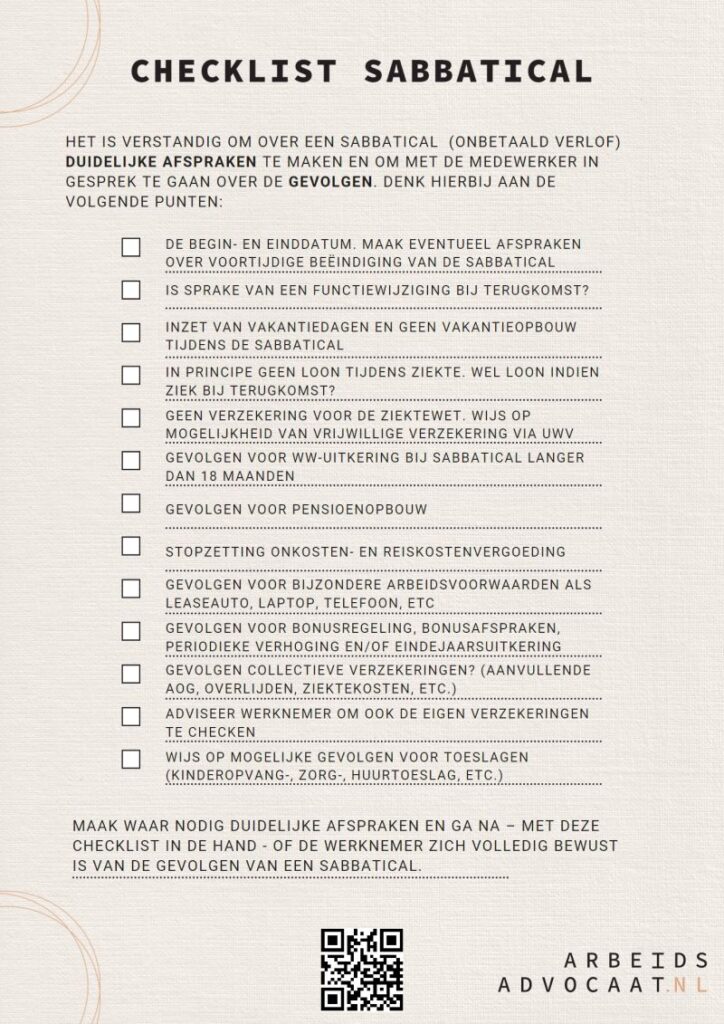
To avoid overlooking anything, it is wise to grab the Sabbatical Checklist. Some important points to consider are:
- Start and end dates of leave
Also document what happens in case of illness or early termination. - Return to same job or not
Is reinstatement guaranteed? Or dependent on circumstances? - Vacation Days and Accrual
During a sabbatical, an employee generally does not accrue vacation days. - Sick pay
In principle, no sick pay is continued during a sabbatical unless otherwise agreed. - Insurance
Consider health, disability and voluntary Sickness Insurance through the UWV. - Pension accrual
Usually pension accrual stops during leave. Actively inform the employee about this. - Expense reimbursements and lease benefits
Record what happens to leased cars, laptops, phones, travel expenses and other benefits in kind. - Collective insurance and benefits
Advise the employee of possible implications for additional insurance and benefits such as rent or child care subsidies.
Practical tips: how to make a sabbatical workable
In general, it is advisable to present a sabbatical in such a way that it also offers benefits to the organization. As an employer, you can encourage this by keeping the conversation positive and open. Consider:
- Ask the employee for a clear plan: What is the reason for the sabbatical? And what will it provide?
- Discuss together how the work will be accommodated: internally or temporarily externally.
- Encourage involvement during the sabbatical: for example, through periodic contact or visiting a (foreign) sister office with international employers.
- Clarify what happens if the employee becomes ill during the leave.
Put agreements in writing
A sabbatical often has labor, financial and tax consequences. It is therefore important to lay down all agreements in writing in an addendum to the employment contract. This way you avoid discussions upon return about rights, duties and expectations.
Conclusion
A sabbatical is never an obligation for the employer, but with the right arrangements, it can be a valuable investment in the employee as well as in the organization. Use the checklist as a basis for the discussion, put agreements in writing and inform the employee well about the legal and financial consequences. This way you create clarity and mutual trust.

This blog was written by mr. Stijn Blom, employment lawyer at Arbeidsadvocaat.nl B.V. Stijn has extensive experience in employment law and supports entrepreneurs and employees on a daily basis with a variety of employment law issues. From dismissal cases to drafting watertight contracts and regulations - with his practical and personal approach, he helps employers and employees move forward. Want to know more? Visit Stijn's page.
Arbeidsadvocaat.nl is happy to think with you if you have questions about sabbaticals. Please feel free to contact us .
April 2025

